Whsts It Called to Use Only Black and White in Art
Monochrome: Painting in Black and White
Issued Baronial 2017
30 Oct 2017 – 18 Feb 2018
Sainsbury Wing
Access charge
Meet differently.
At the National Gallery this fall, journey through a world of shadow and light. With more than fifty painted objects created over 700 years, Monochrome: Painting in Black and White is a radical new wait at what happens when artists cast aside the colour spectrum and focus on the visual power of black, white, and everything in between.
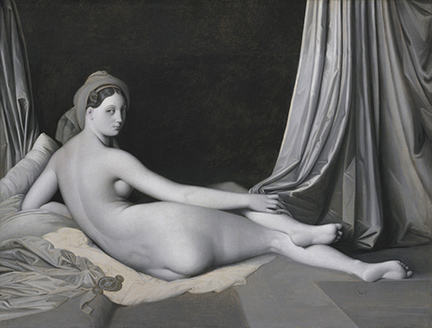
Jean-Auguste-Dominique Ingres and workshop, 'Odalisque in Grisaille', about 1824–34 © The Metropolitan Museum of Art / Art Resources / Scala, Florence
Paintings by One-time Masters such as January van Eyck, Albrecht Dürer, Rembrandt van Rijn, and Jean-Auguste-Dominique Ingres appear aslope works by some of the well-nigh exciting contemporary artists working today including Gerhard Richter, Chuck Close, and Bridget Riley. Olafur Eliasson'due south immersive light installation 'Room for one colour' (1997) brings a suitably mind-altering coda to the exhibition.
With major loans from around the world, and works from the National Gallery'southward Collection, 'Monochrome' reveals fresh insights into the use of colour every bit a choice rather than a necessity.
As Lelia Packer and Jennifer Sliwka, curators of 'Monochrome: Painting in Black and White', explain:
"Painters reduce their colour palette for many reasons, merely mainly equally a way of focusing the viewer'south attending on a particular subject area, concept or technique. Information technology can be very freeing - without the complexities of working in colour, you tin can experiment with form, texture, marking making, and symbolic meaning."
'Monochrome: Painting in Black and White' guides visitors through 7 rooms, each addressing a different attribute of painting in black, white and grey, also known every bit grisaille:
Sacred subjects
The earliest surviving works of Western art made in grisaille were created in the Middle Ages for devotional purposes, to eliminate distractions, and focus the mind. Equally colour pervades daily life, black and white tin can signal a shift to an otherworldly or spiritual context.
For some, colour was the forbidden fruit and prohibited past religious orders practising a form of aesthetic asceticism. Grisaille stained drinking glass, for example, was created by Cistercian monks in the 12th century as an culling to vibrant church windows, with its translucent greyish panels sometimes painted with images in black and yellowish. Light and elegant in advent, grisaille glass such as this window console made for the Royal Abbey of Saint-Denis, Paris (1320–4, Victoria and Albert Museum, London) gained popularity exterior the order and eventually became de rigueur in many French churches.
Studies in light and shadow
From the 15th century onward artists fabricated painted studies in black and white to work through challenges posed past their subjects and compositions. Eliminating color allows artists to concentrate on the way lite and shadow fall across the surface of a figure, object or scene before committing to a full-colour sail. The cute 'Pall Study (mayhap written report for Saint Matthew and an Angel)', (virtually 1477, Kupferstichkabinett, Staatliche Museen zu Berlin) attributed to Domenico Ghirlandaio is a template work which an creative person could reuse in multiple finished color paintings. This particular motif for example reappeared in a frescoed vault in San Gimignano, Italy.
Independent paintings in grisaille
Increasingly, paintings in grisaille were made as independent works of art, complete unto themselves. This section explores the inspiration and want for such paintings, prized for their demonstration of artistic skill, for the insights they provide into the creative person's craft, and for their profound consideration of a particular field of study.
Jan van Eyck's 'Saint Barbara' (1437, Purple Museum of Fine Arts Antwerp) is the primeval known instance of a monochrome piece of work on panel, fatigued in metalpoint, Bharat ink, and oil on a prepared footing. Although at that place has been ongoing debate as to whether a master colourist such as van Eyck intended 'Saint Barbara' as a sketch in preparation for a painting in color or a every bit a finished drawing, the console was admired and collected equally early on as the 16th century suggesting that a taste for independent monochrome pictures existed from an early date.
Monochrome painting and sculpture
For centuries artists accept challenged themselves to mimic the appearance of stone sculpture in painting. In Northern Europe, a taste for illusionistic decorative elements – such equally decorative wall painting and sculpted stucco – may have helped give rise to stunning works of trompe l'oeil painted on panel or sail. Jacob de Wit excelled at this practice and his 'Jupiter and Ganymede' (1739, Ferens Art Gallery, Hull) could easily exist mistaken for a three-dimensional wall relief.
Monochrome painting and printmaking
Beginning in the 16th century, painters developed ingenious ways to compete with new developments in printmaking. An exceptionally rare grisaille piece of work by Hendrik Goltzius, 'Without Ceres and Bacchus, Venus Would Freeze' (1606, the Country Hermitage Museum, St Petersburg) for case, dazzled viewers who could not fathom how information technology was fabricated, as it very much looks like a print but was drawn by hand on prepared canvass.
Black-and-white painting in the age of photography and moving-picture show
Similarly, the invention of photography in 1839, and that of moving picture much later, prompted painters to imitate the effects of these media, in guild to respond to, or compete with their item qualities. Gerhard Richter employed a press photograph of a prostitute who had been brutally murdered as the foundation of his painting 'Helga Matura with Her Fiancé' (1966, Museum Kunstpalast, Düsseldorf). The grey palette – for Richter, 'the ideal colour for indifference'– removes any sentimentality most Helga's murder. By deliberately blurring the photograph, the artist makes the viewer aware that this is an altered epitome, contrasting with the crispness and apparent objectivity of the original.
Abstraction
Abstruse and installation artists have frequently been drawn to black and white. When artists accept ready access to every possible hue, the absence of colour can exist all the more shocking or idea-provoking. In 1915, Kiev-built-in artist Kazimir Malevich painted the first version of his revolutionary work, 'Blackness Square' (in the exhibition is the 1929 version from the State Tretyakov Gallery, Moscow) – an eponymous black square floating within a white painted frame – and alleged it to be the commencement of a new kind of not-representational art. Works by Josef Albers, Ellsworth Kelly, Frank Stella, and Cy Twombly all exemplify the employ of minimal colour for maximum impact.
Artists intrigued past color theory and the psychological effects of colour (or its absenteeism) manipulate lite, infinite, and hue to trigger a detail response from the viewer. In this way, Olafur Eliasson brings the exhibition to a close with his big-calibration, immersive light installation, 'Room for ane colour' (1997). In a room illuminated with sodium yellow monofrequency lamps, all other light frequencies are suppressed and visitors are transported to a monochrome globe.
National Gallery Director, Dr Gabriele Finaldi, says:
"Artists cull to use black and white for aesthetic, emotional, and sometimes even for moral reasons. The historical continuity and diversity of monochrome from the Heart Ages to today demonstrate how crucial a theme information technology is in Western art."
Exhibition organised by the National Gallery in collaboration with Museum Kunstpalast, Düsseldorf.
NOTES TO EDITORS
Exhibition generously supported by Howard & Roberta Ahmanson
with additional support from The Vaseppi Trust and other donors
Paradigm:
Jean-Auguste-Dominique Ingres and workshop
'Odalisque in Grisaille', most 1824–34
Oil on sail, 83.two × 109.ii cm
© The Metropolitan Museum of Art / Art Resource / Scala, Florence
Location: Sainsbury Wing
Press view: 26 October 2017 (10.30am–1.30pm)
Open to public: 30 October 2017
Daily 10am–6pm (last admission 5pm)
Fridays 10am–9pm (last access 8.15pm)
Admission charge
Members and under-12s (ticket required) Gratis
Booking tickets
For advance tickets to 'Monochrome: Painting in Black and White' please visit nationalgallery.org.uk or call 0800 912 6958 (booking fee). You tin also book tickets in person from the Gallery.
Overseas customers can contact us by dialling +44 020 7126 5573.
Pre-book online and relieve.
For farther information, please contact the National Gallery Press Role on 020 7747 2865 or email press@ng-london.org.uk
Publicity images can exist obtained from https://press.nationalgallery.org.uk/annal.
Source: https://www.nationalgallery.org.uk/about-us/press-and-media/press-releases/monochrome-painting-in-black-and-white
0 Response to "Whsts It Called to Use Only Black and White in Art"
Post a Comment